
WEAPONS
There was a lot of hype around writer-director Zach Cregger’s follow-up to the promising Barbarian – I remember noticing a website ranking the characters in Weapons in order of how ‘iconic’ they are.
No doubt it is old-fashioned of me to expect to wait a few years before something is accorded ‘iconic’ status, but things move fast nowadays. Or perhaps the assumption now is that everything is iconic, it is just a matter of establishing the degree, and as soon as possible.
At the risk of adding to the hype I can say that I thought Weapons was pretty good. Pushing it further, I might go on to say that it delivers the kind of state-of-the-nation address that Ari Aster’s Eddington was intended to be, but more effectively, and without even trying.
Although I say that without having seen Eddington, only the poster. And the trailer. Which were enough.
(Though now John Waters has chosen it as his number one film of last year – ‘If you don’t like this film I hate you’ – I feel I ought to make the effort.)
Weapons has all but one child out of a kindergarten class fleeing their homes at 2:17 in the morning, never to be seen again. Or at least, this is what a child’s voiceover tells us; actually they are seen again. This film is not 100% trustworthy.
Suspicion falls on the kids’ teacher Justine (Julia Garner), though the police have cleared her. You can imagine various conspiracy theories doing the rounds, possibly involving Hilary Clinton, but as this is no sprawling satire, and instead is constructed like a thriller, we don’t have time for that, and instead the film focusses tautly on Justine’s (legitimate) paranoia.
At least, it does for a while: echoing Pulp Fiction, the film is structured through multiple perspectives, beginning with Justine and moving on to take in Josh Brolin’s angry parent Archer, Justine’s policeman ex Paul (Alden Ehrenreich) and a homeless drug addict James (Austin Abrams) as it skilfully (mis)directs us towards a singularly barmy explanation.
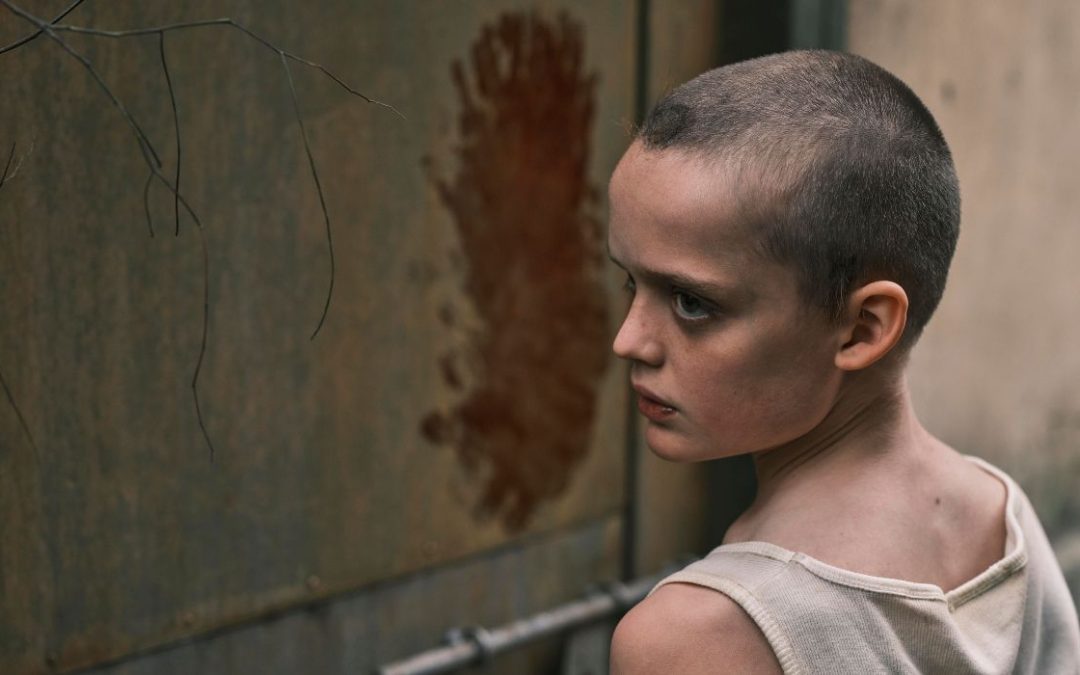
The kids are in fact in the house of the one boy who didn’t disappear, Alex, drawn there by his Aunt Gladys, an actual witch, nicely played by Amy Madigan (channeling Ruth Gordon and Art the Clown and sometimes bringing to mind a demonic Grayson Perry).
She is keeping the zombified kids in the basement where she somehow draws nourishment from them to ward off the effects of illness and old age. She has also reduced Alex’s parents to a biddable state, leaving only Alex untouched, presumably because she needs an intermediary with the outside world.
Or is there another reason? The fact that Alex seems to be an unpopular, bullied child might lead us to suspect that he is complicit in the fate of his classmates – but since he is apparently horrified by Aunt Gladys’ behaviour, and ultimately turns the tables on her, that doesn’t play, unless we theorise that he summoned her (or a something which turned out to be her) only to rapidly regret it.
Which could be the moral. The film’s title evokes the possibility that this could be a high school shooting tragedy through a very cracked lens, with Alex as the perpetrator and Aunt Gladys as the ‘weapon’ – a weapon whose use quickly reveals itself as disastrously excessive (Alex later successfully ‘weaponizes’ his own classmates against Aunt Gladys, who, in an extraordinary climax, is eaten by them).
Or is that drawing too much from a film which takes us from a metaphorical witch hunt (of Justine) to a real one? Some viewers have taken exception to the simplistic quality of the film’s explanation (which even then still leaves questions unanswered) when it initially suggested that a complex puzzle was being unravelled.
But this is why it suits Trump’s America so perfectly, with its rush to easy answers (which then turn out not be so easy after all). It starts out with a relatively sophisticated notion of the witch as a persecuted woman and ends up with a witch out of Roald Dahl but nastier. That this is not quite believable is not a problem, since neither is Trump’s America.
A sense of humour is at work, which helps with the plausibility issues (‘What the fuck!?’ screams Archer on awakening from a particularly long and obscure dream sequence, as if voicing the audience’s confusion). And Gladys is absurd but also genuinely horrifying, as in the scene where she compels head teacher Marcus (Benedict Wong) to beat his husband to death using his own head. This is the first scene in which we become aware of her powers and it is almost as if the film is using this exaggerated violence to enforce our belief in a frankly incredible plot twist.
Which also seems indicative of how the world works now.
BRING HER BACK
Like Zach Cregger, directors Danny and Michael Philippou gained a lot of attention with their taut, well-conceived debut Talk To Me, and have followed it up with something more ambitious here. I’m not sure that it quite comes off.
It’s also about a sort of ‘witch’, but Laura, our protagonist here (Sally Hawkins) has blundered her way into the role, having uncovered some footage of a ritual on the internet which looks like it might serve to bring her daughter, who drowned in their swimming pool, back from the dead.
To this end she has fostered Piper, a partially-sighted girl who she hopes will serve as a vehicle for her dead daughter’s soul (presumably she didn’t declare this on the forms). Unfortunately – for Laura – Piper has an older brother, Andy (Billy Barratt), who she does not want to be separated from and much of the most effective work here is around Laura’s attempts to alienate Piper from her half-brother by presenting him as a violent and unstable example of ‘toxic masculinity’.
The scenario is further complicated by Oliver, another child staying with Laura, a mute boy clearly suffering from creepy child syndrome, so that you’re slightly surprised that he isn’t kept locked up in the attic or cellar (he is locked in his bedroom quite a bit). As it turns out he is a boy Laura has kidnapped and had possessed by the demon (or, as she maintains, angel) who will hopefully facilitate the upcoming soul-transfer.
At one point Oliver starts chewing on a carving knife, but isn’t taken to hospital (where someone might have recognised the kidnapped child from his image on a poster). There is a sense that, while we are admiring Sally Hawkins’ fine, nuanced performance as a grief-stricken mother, probability levels are dropping in the background.
After all, Laura is also a demon-summoning, child-snatching mother who keeps her daughter’s body in the freezer, and I got the feeling by the end that high-camp histrionics might have better suited the film than nuance.
The Philippou brothers are perhaps ‘maturing’ – but prematurely, with a film that isn’t quite able to make low-key domestic horror gel with full-on supernatural shenanigans. Nice try though.
Recent Comments